



Superior AI is driving clever automation for excavators and loaders worldwide, delivering productiveness beneficial properties whereas addressing important labour shortages going through the trade
Autonomous applied sciences are more and more reshaping the development panorama. From remote-controlled dozers working in hazardous environments to AI-powered programs optimising earth-moving operations, the trade is witnessing a technological revolution that guarantees to redefine productiveness, security and operational effectivity. Whereas mining has lengthy embraced autonomous haul vans and drilling programs, development websites – with their dynamic situations and always altering undertaking specs – current far better challenges for automation. But it’s exactly inside this complexity that the best alternatives lie. Main this cost by bringing clever automation to excavators and loaders throughout development websites worldwide is Swiss firm, Gravis Robotics.

Based as a technical college spin-out from ETH Zurich, Gravis Robotics advantages from Switzerland’s thriving robotics trade – the nation has main funding from world know-how firms reminiscent of Google and Anthropic. Ryan Luke Johns, Gravis Robotics’ CEO, describes the corporate’s unconventional origins. “We grew out of a lab that was making use of AI-based management to quadruped (four-legged) robots, and began wanting into transferring that know-how to the Menzi Muck strolling excavator,” he says. “Ultimately we migrated this superior management onto extra typical hydraulic machines.”
The tech behind the transformation
On the coronary heart of Gravis Robotics’ answer lies its retrofit equipment – the Rack. This method integrates 5 surround-view cameras, lidar sensors for 3D sensing, onboard computing energy, GPS positioning and a wi-fi pill interface known as Slate. The know-how transforms typical excavators and loaders into clever machines able to autonomous operation whereas sustaining full handbook management capabilities.
“Solely probably the most extremely expert and skilled operator may match the accuracy of an autonomous system”
The Slate pill represents an important innovation in consumer interface design. Not like conventional machine-control programs that show cryptic grade data, Slate offers intuitive, real-time 3D visualisation. Blue areas point out the place materials wants eradicating, inexperienced reveals on-grade areas and yellow or crimson highlights sections requiring fill. This visible system updates constantly as work progresses, offering operators with instant suggestions whether or not working autonomously or manually.
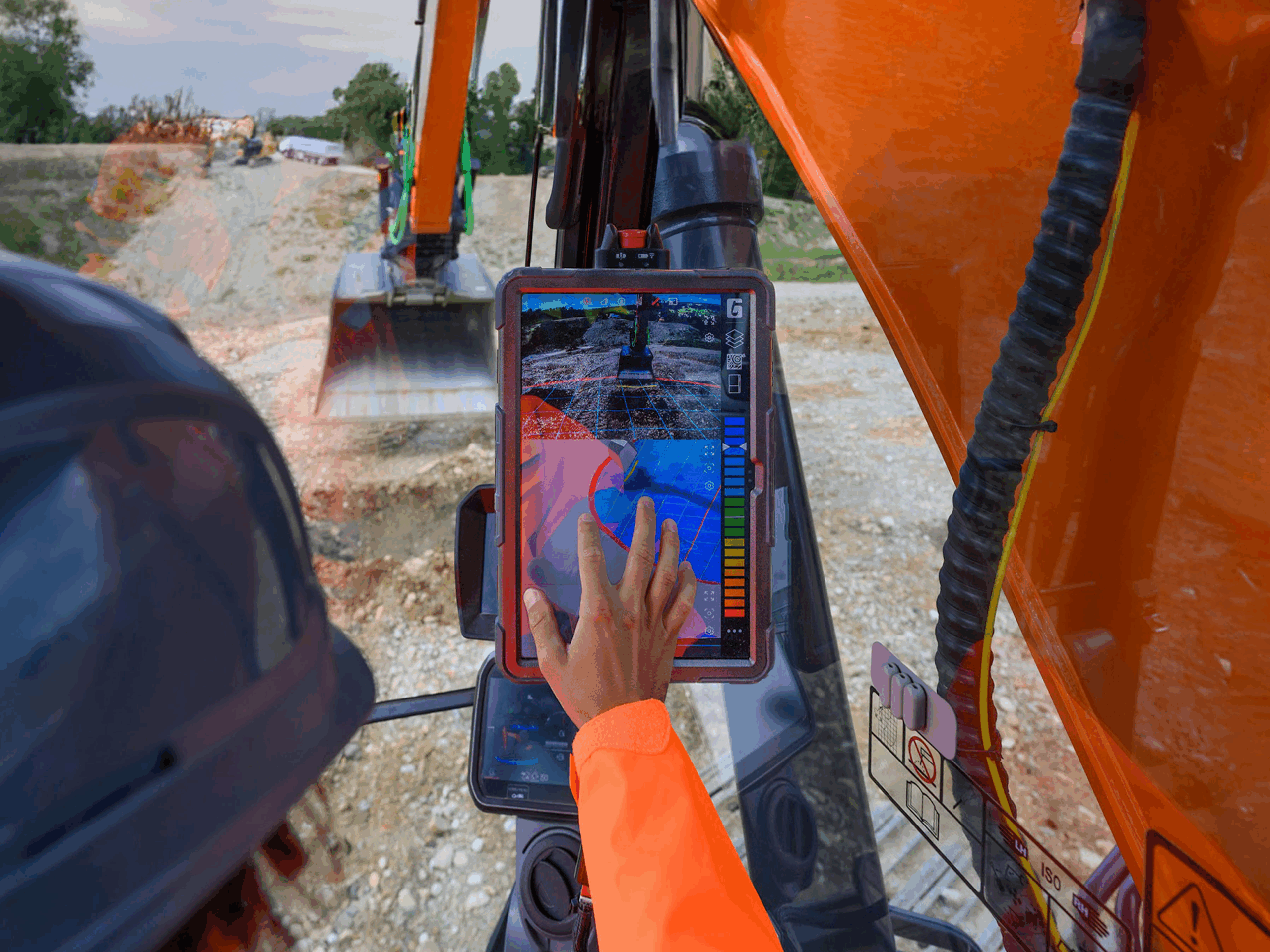
The system’s intelligence stems from machine studying algorithms educated in simulated environments throughout numerous terrain situations. Reasonably than counting on rule-based programs, the AI learns to optimise digging methods by analysing soil hardness by hydraulic stress information, terrain shapes, and GPS data. The result’s a system that constantly achieves full bucket masses while adapting to various floor situations – from comfortable earth to hidden rocks –usually outperforming skilled operators in particular duties.
“When the bottom is basically comfortable, it takes a really full scoop,” says Johns. “When there’s a rock hidden that it might’t see, it gently feels it and nonetheless comes up with a full scoop with out getting caught.” This sensitivity interprets into constant cycle occasions and productiveness beneficial properties that may attain 30% enchancment over handbook operation in bench-marked situations.
The convergence of a number of technological elements made Gravis Robotics’ imaginative and prescient viable. “The massive alternative in automotive self-driving has facilitated an enormous drop in the price of {hardware} reminiscent of lidar, cameras, and edge computing,” says Johns. “There’s additionally been a lift in talents with AI, enabling machines to adapt to the complexities of the bottom and the worksite.”
Gravis Robotics, nonetheless, needed to deal with the problem of integrating its answer with totally different hydraulic programs. “The behaviour of hydraulic programs can fluctuate between OEMs, size-classes, and interfaces,” says Johns. “Efficiency may even differ between two machines of the identical make and mannequin or on the identical bodily machine over time. Our answer is ready to adapt to those variations to maximise productive management of the machine. We provide interface options that help each electrohydraulic machines or typical hydraulic pilot stage machines. The problem, and the important thing worth in our AI-native strategy, is to have one autonomous agent that may adapt to those variations. Our learning-based AI adapts to the distinctive traits of every machine’s hydraulics and geometry, letting one software program answer work throughout totally different pumps and hydraulic configurations.”
Because the adoption of autonomy in development has elevated, OEMs at the moment are shifting towards electrohydraulic machines. “Transitioning to digital joystick alerts from typical hydraulic pilot stage management makes it simpler for us to plug-in a retrofit laptop and instantly management machines,” says Johns.
Driving OEM adoption
Since its first work with Menzi Muck, Gravis Robotics has secured collaborations with main development OEMs, as demonstrated at Bauma in April 2025. The corporate showcased autonomous truck loading at Develon’s sales space, demoed dwell teleoperation with Menzi Muck, unveiled an autonomous loader with Case, had been on show at Sumitomo’s sales space, and hosted an autonomous Yanmar machine on the Gravis sales space.
One of many key partnerships for Gravis Robotics was with KTEG, a three way partnership between Hitachi Development Equipment and Kiesel Technologie Entwicklung, a subsidiary of the Hitachi supplier for Germany, Austria and Poland.
The collaboration on the ZE135 battery-powered excavator demonstrated how autonomous applied sciences can combine with different trade traits, notably electrification. “In our demo space at Bauma, the machine operated autonomously,” says Timo Vestweber, advertising and gross sales help supervisor at KTEG. “It acquired its work directions, reminiscent of excavating a trench, by way of a pill and executed them independently. The mixture of zero-emission know-how and synthetic intelligence elevates the KTEG ZE135 to a brand new stage of innovation and demonstrates the way forward for autonomous, emission-free development,”
Addressing trade issues
From labour shortages to productiveness calls for, the development trade faces challenges that autonomous know-how seeks to deal with, as Johns explains. “When individuals take into consideration autonomy on this trade, they assume the primary objective ought to be to take away the human operator within the cab. Nevertheless, our objective is to extend productiveness – to maneuver extra earth whereas decreasing inefficiency and rework from handbook grade checking. If we take a look at the calls for of the trade, the declining labour productiveness and lack of employees –it is a big want. Our objective is to drive productiveness to be 30% sooner, and if that’s 50% autonomy and 50% augmentation or 90% autonomy and 10% augmentation – that’s nice for the client as a result of they’re in a position to get extra throughput with the operators they’ve.”
“Our studying AI adapts to the distinctive traits of every machine’s hydraulics and geometry, letting one software program answer work throughout totally different configurations”
Though autonomous excavators are nonetheless within the growth part, Vestweber echoes Johns’ recognition of the potential of those applied sciences to deal with productiveness issues. “They’ve the potential to work across the clock which can scale back undertaking completion time, permit contractors to make higher use of assets and lower your expenses – it additionally means they will tackle extra jobs, rising profitability,” says Vestweber. “Efficiencies are additionally to be discovered within the execution of the work. Solely probably the most extremely expert and skilled operator may match the accuracy of an autonomous system, for instance in relation to excavating the exact quantity of supplies to be faraway from a web site. Plus, by harnessing huge information, they may have the ability to assess their very own efficiency and allow predictive upkeep.”
When it comes to security issues for operators, Vestweber highlights how autonomous machines can play their half in maintaining accident charges to a minimal. “Operators would not be uncovered to hazardous working situations. Autonomous machines would additionally not make errors as a result of operator fatigue.”
Increasing adoption
Gravis Robotics’ emphasis on excavators and loaders displays market realities – these machines characterize round 90% of development gear gross sales by quantity, excluding haul vans. With machines now deployed throughout Switzerland, Germany, Netherlands, Japan, the UK and US, Gravis Robotics focuses on increasing deployments to assemble operational information throughout various web site situations and machine varieties. “The trade response has been encouraging,” says Johns. “There’s a powerful understanding that the market is shifting to autonomy. It’s now a query of how we get these programs to the end-users quick sufficient to get the suggestions we have to perceive how we’re collectively incorporating the know-how into the positioning, and the way we’re shaping the panorama of the long run.”
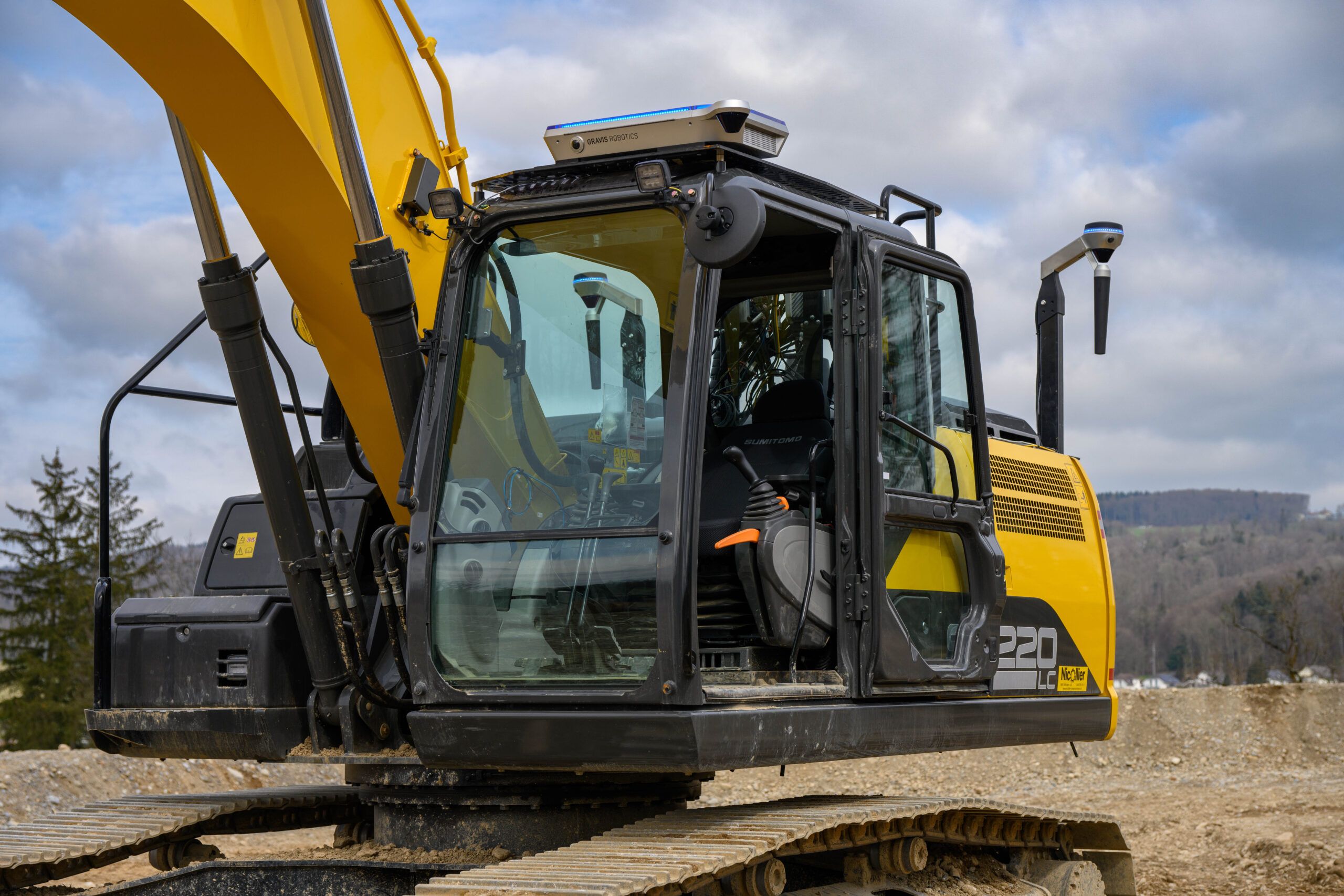
This widespread deployment extends past particular person machine efficiency. “What advantages the system is massive deployments over many websites with many kinds of machines,” says Johns. “So we’re actually in a position to look throughout the board and say ‘Sure, we’re constantly in a position to ship elevated productiveness’.”
Trying ahead, KTEG sees potential for scaling autonomous programs to bigger machines the place the financial advantages develop into extra pronounced. “The price of autonomous programs can be related when it’s in smaller fashions,” says Vestweber. “However by way of manufacturing – as within the quantity of fabric moved per hour – it should develop into cheaper in bigger excavators.”
An autonomous future
The collaboration between know-how firms and established OEMs alerts a brand new period for development gear. “The core motivation for the tip customers and OEMs is to have an early grasp on the way forward for autonomy,” says Johns. “We’re ensuring that the appropriate gamers are on the desk to deliver probably the most worth and driving the trade ahead. It’s a really thrilling time for everybody concerned.”
As the development trade grapples with labour shortages and productiveness calls for, autonomous know-how gives a pathway ahead. By means of operator-friendly options that increase quite than exchange human functionality, the way forward for development lies not in eliminating the human component, however in intelligently enhancing it to realize beforehand not possible ranges of effectivity and precision.
This text first appeared within the October challenge of iVT
