



Observe us right now…


Trendy automotive know-how, designed to reinforce security and comfort, often introduces unexpected challenges. One such occasion has emerged with Kia’s superior driver-assistance techniques, the place a function meant to seamlessly combine with posted pace limits is as an alternative creating doubtlessly hazardous conditions. This problem, centered across the misinterpretation of particular highway indicators, raises crucial questions in regards to the robustness of those techniques and the duty of each producers and drivers.
A Kia EV6 GT-Line AWD proprietor just lately shared a regarding expertise on social media, detailing how their automobile’s adaptive cruise management system misinterpreted route indicators for pace limits, resulting in harmful pace changes. The person, recognized as sdague, posted the next account:
“Round right here, there are a few roads which might be labeled 9D and 9H (there may be additionally a 9W, 9P, and 9G… welcome to the Hudson Valley of NY).
In my Kia EV9, I’ve now had it learn these route indicators as pace limits, and flag it as 90 or 95 mph (it occurred final night time coming down 9H). If I am simply driving, it is wonderful. Nevertheless, within the EV6, there may be the power to have the adaptive cruise management alter robotically primarily based on pace restrict, and at the least on one event, I’ve had it determine it was time to stand up to 90 mph.
I am not even positive how one can report a factor like this to Kia. Any ideas?“
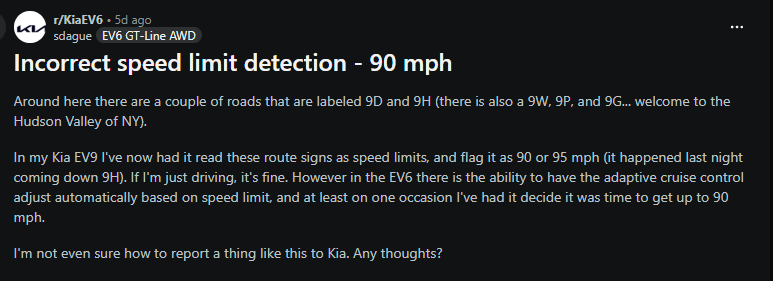
The core of the issue lies within the automobile’s incapability to distinguish between route markers, akin to “9D” or “9H” frequent in New York’s Hudson Valley, and precise pace restrict indicators. When the adaptive cruise management is engaged with the automated pace adjustment function, this misidentification can immediate the EV6 to speed up to an alarming 90 or 95 mph, far exceeding authorized and secure speeds. This is not merely a show error; it is a direct command to the automobile’s powertrain, posing a major danger to the motive force and different highway customers.
One commenter, humanthrope, expressed skepticism about producer responsiveness whereas suggesting an alternate: “humanthrope • 4d in the past • Edited 4d in the past EV6 Wind AWD I feel it’s uncertain that Kia would deal with something like this in a timeframe that we people dwell in.
However in case you’re technically inclined, you may think about taking a look at a Comma working Sunnypilot. For these automobiles, it’s principally a much-improved lane-keeping help that integrates with the sensible cruise management to regulate the restrict. It’s additionally open supply, so potential issues like this may be addressed by the group. For me, the expense was very a lot value it.”
This sentiment, whereas maybe cynical, displays a standard frustration amongst homeowners coping with software-related automobile points. The suggestion to resort to aftermarket, open-source options like Comma.ai’s Sunnypilot system reveals a crucial hole: if a producer’s superior driver-assistance techniques (ADAS) are unreliable, homeowners will search their very own fixes, even when these options function outdoors the OEM’s validated parameters.
Kia EV6: Understanding Superior Driver-Help System Limitations
- The Kia EV6 GT-Line AWD is provided with superior driver-assistance techniques (ADAS), together with Freeway Driving Help 2 (HDA2) and Good Cruise Management. These techniques use cameras and radar to keep up pace, observe visitors, and interpret highway indicators.
- The reported problem particularly includes the system’s potential to misread route indicators (e.g., “9H”) as pace restrict indicators, resulting in inaccurate pace changes. This reveals a crucial flaw within the system’s picture recognition and contextual processing.
- Whereas ADAS options intention to reinforce security and luxury, incidents like this reveal the need for drivers to stay absolutely engaged and ready to override automated techniques. No present ADAS is an alternative choice to an attentive human driver.
- Automakers are repeatedly updating these techniques through over-the-air (OTA) software program updates, however the detection and fast deployment of fixes for safety-critical bugs stay a major problem. This incident calls for a swift and efficient software program treatment.
This creates a regulatory grey space and shifts the burden of security and reliability onto the buyer, a place no main automaker ought to condone. The concept homeowners ought to have to switch their automobile’s core driving help techniques to attain fundamental performance is an indictment of the OEM’s software program improvement and validation processes.
One other person, EV-Bug, provided a extra direct, if considerably dismissive, perspective on the motive force’s duty: “u/EV-Bug avatar EV-Bug • 4d in the past EV6 Wind RWD Anybody permitting their automotive to regulate their pace primarily based on the indicators is simply asking for hassle. I seen the show exhibiting a 15 mph pace restrict in a college zone throughout off-hours and weekends. I admire reminders, however have a conscience to regulate my pace.”
Whereas driver vigilance is paramount, this remark misses a elementary level about ADAS. These techniques are marketed as aids, designed to cut back driver workload and improve security. To recommend {that a} driver is “asking for hassle” by trusting a system explicitly designed to robotically alter pace primarily based on detected limits undermines your entire premise of such know-how. It is akin to blaming a pilot for trusting an autopilot system that all of a sudden makes an attempt to dive. The expectation is that the system, as soon as engaged, will carry out its operate reliably, not that it’s going to require fixed, minute-by-minute override for fundamental security. The onus should be on the producer to ship a system that works as marketed, not on the motive force to consistently second-guess its elementary operations.
Additional corroborating the problem, Mewtwo_EX confirmed experiencing the identical “95mph bug”: “mewtwo_EX • 4d in the past EV6 GT-Line AWD It solely auto adjusts to speeds 45mph and above. I’ve skilled the 95mph bug a few instances. In any other case, it is fairly good to have it auto-switch from 45 to 55 and again when rolling by means of rural areas. I do find yourself overriding it anyway because it does not truly pace up or decelerate in time. I would take your recommendation and disable it.”
This affirmation from one other proprietor, particularly noting the 45 mph threshold for auto-adjustment, solidifies the existence of a systemic flaw. The truth that this “bug” impacts a number of automobiles and may set off speeds as much as 95 mph is deeply troubling. Whereas the comfort of computerized pace changes in rural areas is acknowledged, the potential for a sudden, harmful acceleration to almost triple the authorized restrict on a misidentified highway signal far outweighs any perceived profit. This is not merely an inconvenience; it is a security defect that calls for quick consideration and a strong software program patch from Kia.
The informal acceptance of such a crucial flaw, with customers contemplating disabling the function completely, speaks volumes in regards to the present state of ADAS reliability. Automakers are dashing to implement these applied sciences, however typically overlook the real-world complexities that may flip a comfort function right into a legal responsibility. The “automobiles simply attempting to save lots of you time” quip from ForwardBias, whereas humorous, reveals the inherent danger when know-how oversteps its bounds with out adequate validation.
This incident is a stark reminder that superior driver-assistance techniques, regardless of their refined algorithms and sensors, are solely as dependable as their programming and the info they interpret. Kia, like all producers deploying such options, has a duty to make sure that their techniques aren’t simply practical however demonstrably secure in each conceivable real-world situation. A system that may misread a route signal for a 90 mph pace restrict is not only inconvenient; it is a ticking time bomb on public roads.
Picture Sources: Kia Media Heart
Noah Washington is an automotive journalist primarily based in Atlanta, Georgia. He enjoys masking the newest information within the automotive business and conducting opinions on the newest automobiles. He has been within the automotive business since 15 years previous and has been featured in distinguished automotive information websites. You’ll be able to attain him on X and LinkedIn for suggestions and to observe his automotive protection.
Observe us right now…
